



COMMERCIAL DRY BEAN SOAKING PROCESS: WHAT “GOOD” LOOKS LIKE ON THE PLANT FLOOR
A commercial dry bean soaking process isn’t “just adding water.” It’s a controlled hydration step that sets the ceiling on blanching performance, cooker throughput, split rate, texture, yield, and wastewater loading. We see it constantly: plants chase cooker problems when the real issue started two steps earlier in the soak tank.
Today’s operating environment—tight labor, higher utility costs, SKU proliferation, stronger food safety scrutiny—is forcing processors to revisit soak fundamentals. The goal: stabilize output and reduce operator dependency before product ever hits the blancher.
This article breaks down the soaking process from an operations and engineering standpoint. What to measure. What typically goes wrong. What to standardize so your blanchers, cookers, coolers, and screens run predictably.
WHY SOAKING IS GETTING MORE ATTENTION RIGHT NOW
Across North American bean and ready-meal lines, the “soak step” is getting pulled into continuous improvement projects for three reasons:
- Throughput and capacity constraints: Soak variability becomes cooker bottlenecks, more rework, and less effective line balancing. If hydration is inconsistent, your cooker can’t hold a steady retention time.
- Energy and water inflation: Over-soaking and excessive dump-and-fill cycles inflate water use, heating load, and wastewater surges. That shows up on the utility bill and in compliance reports.
- Food safety and sanitation expectations: Auditors and customers demand more documented controls around time/temperature, allergen segregation, and hygienic design. “We’ve always done it this way” doesn’t pass anymore.
COMMERCIAL DRY BEAN SOAKING PROCESS: CORE VARIABLES TO STANDARDIZE
Predictable hydration means predictable downstream cooking. These variables must be controlled and recorded—not left to operator judgment.
1) WATER-TO-BEAN RATIO (AND TRUE UNIFORMITY)
Operators know the rule of thumb. Plants struggle with consistency. Non-uniform distribution causes:
- zones of under-hydrated beans (hard centers, longer cook times),
- zones of over-hydrated beans (split skins, mushy texture),
- unstable discharge flow into blanching/cooking.
Practical takeaway: Standardize fill volumes and loading methodology. Verify distribution (not just level). Prevent “piling” that creates hydration gradients.
2) TIME AND TEMPERATURE (THE TWO BIG LEVERS)
Time and temperature drive hydration rate. They also influence:
- microbial growth risk windows,
- texture development,
- skin integrity and split rate.
Practical takeaway: Define a target soak window by bean type. Control temperature tightly enough that “summer vs. winter” water temperature doesn’t shift your cook profile.
3) BEAN VARIETY, AGE, AND INBOUND MOISTURE (RAW MATERIAL REALITY)
Crop year variability and storage conditions change hydration curves. If your incoming dry beans swing in initial moisture, size distribution, or defect load, your soak “recipe” must anticipate it.
Practical takeaway: Treat incoming moisture and defect % as process inputs, not “quality notes.” Trend these values. Preemptive adjustments beat chasing problems after the cooker goes unstable.
4) AGITATION AND GENTLE HANDLING
Aggressive agitation increases splits. Too little movement causes channeling and uneven hydration. The plant-floor problem shows up later as:
- clumping in blanchers/cookers,
- uneven thermal processing,
- higher fines loading in liquid-solid separation.
Practical takeaway: Uniform bean contact with water, without mechanical abuse—especially with delicate varieties.
WHAT “BAD SOAKING” LOOKS LIKE DOWNSTREAM (AND HOW IT SHOWS UP IN DATA)
Soak issues rarely stay in the soak area. They propagate.
- Cooker retention time creeps up → capacity loss, scheduling pressure.
- Texture complaints increase → more QA holds, rework, customer rejects.
- Cooling becomes inconsistent → greater risk staying above critical temperatures longer than planned.
- Wastewater solids rise → more screen blinding, higher disposal costs, potential compliance headaches.
If you track only “soak time,” you miss the story. Track outcomes:
- split rate (%),
- hydrated yield (% gain),
- cooker setpoint vs. achieved texture,
- fines and solids loss.
SANITATION AND HYGIENIC DESIGN: THE SOAK STEP’S HIDDEN COST CENTER
Soak systems often become:
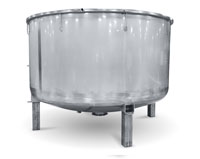
- hard-to-drain,
- hard-to-access,
- prone to residue accumulation.
That drives labor hours and increases sanitation variability.
Practical takeaway: Look for self-draining geometry, cleanable corners, and predictable discharge. Less trapped water equals less downtime and fewer sanitation surprises.
PROCESS IMPROVEMENT CHECKLIST (HIGH IMPACT, NO CAPITAL REQUIRED)
If you’re evaluating your commercial dry bean soaking process, start here:
- Define hydration targets by SKU (moisture gain or texture proxy).
- Lock in water-to-bean ratio and loading procedure.
- Control soak temperature with a documented tolerance band.
- Reduce operator variation with simple, visual standards.
- Measure splits, yield gain, and solids loss weekly—trend them.
- Confirm downstream equipment is matched to the hydration profile.
HOW SOAKING CONNECTS TO BLANCHING, COOKING, AND COOLING
Most plants evaluate soaking in context of the whole line:
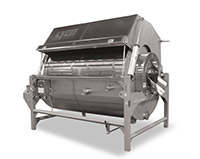
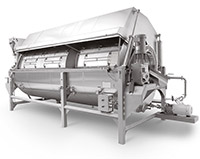
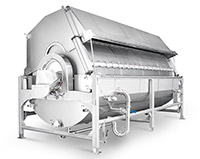
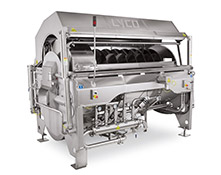
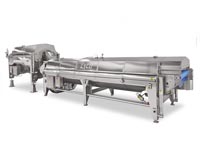
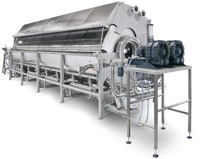
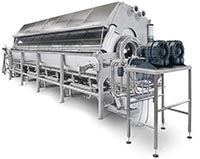
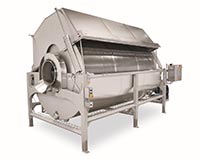
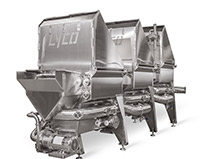
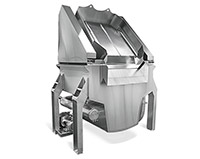
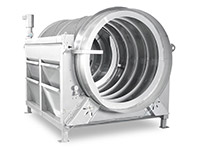
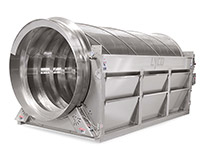
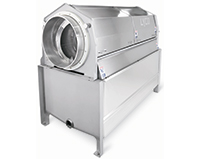
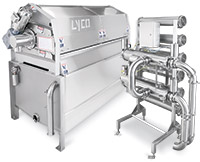
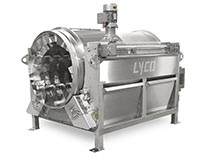
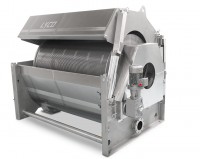
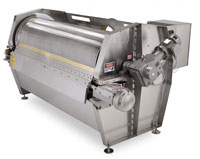
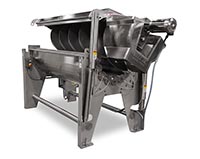
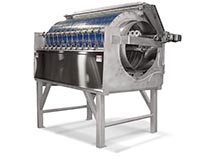
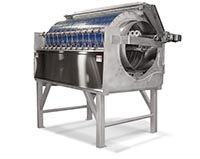
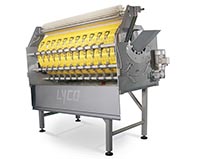
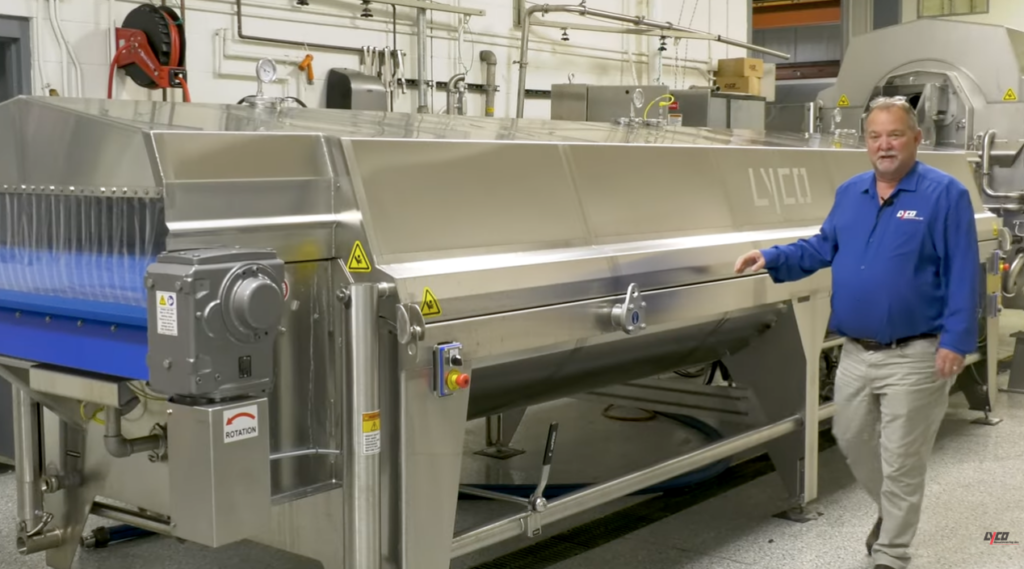
- Continuous Hydrating with Blanching/cooking: Consistent hydration supports stable retention time control and uniform thermal processing. The Rotary Drum Blancher® handles 2–60 minute retention times with gentle agitation and uniform temperatures—over 850 sold worldwide.
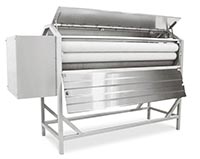
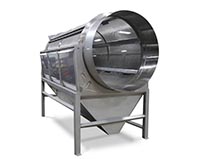
- Soak/cook discharge → Screening: Splits and fines become wastewater solids. Better soaking means less screen blinding and lower disposal costs.