




FULLY ABSORBED RICE COOKING PROCESS: WHAT IT IS, WHY IT’S TRENDING, AND HOW PLANTS CONTROL IT
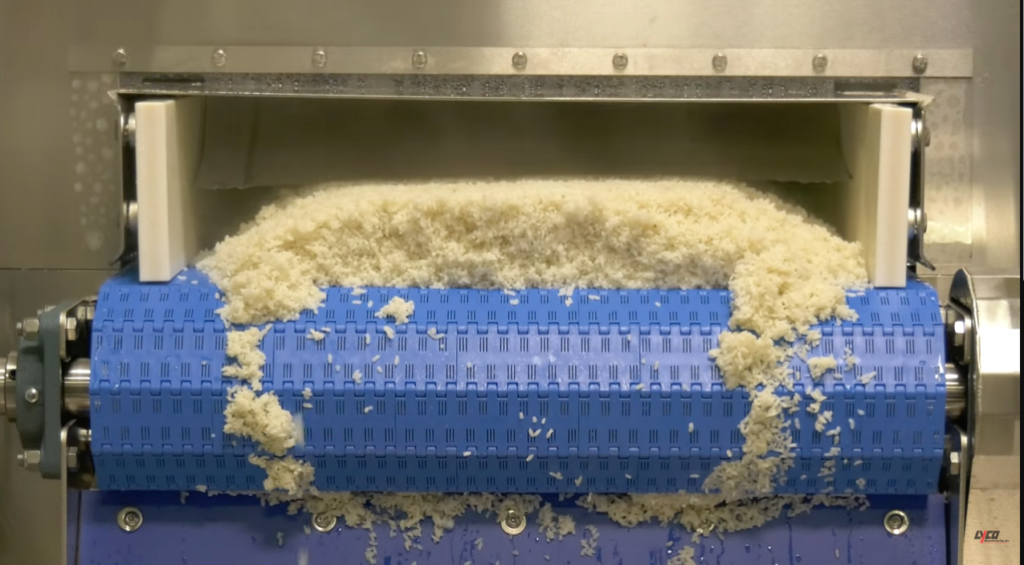
Prepared meal volumes are climbing. SKU counts keep expanding. Labor stays tight. And retailers are pushing tighter quality specs—especially for rice going into bowls, burritos, tray meals, and frozen entrées.
That’s why the fully absorbed rice cooking process is getting renewed attention on plant floors across the industry.
This approach delivers repeatable texture, controlled moisture, and lower water discharge compared to “cook-in-excess-water then drain” methods that drift batch-to-batch. We’re not talking recipes here. We’re talking plant-floor controls: hydration, heat, retention time, agitation, and sanitation—all tuned to produce low-moisture, fully cooked rice ready for mixing, chilling, IQF, forming, or packaging.
WHAT “FULLY ABSORBED” MEANS IN INDUSTRIAL RICE COOKING
In a fully absorbed rice cooking method, the rice takes up essentially all the added water during the cook cycle. That means minimal free water at discharge, reduced need for aggressive liquid-solid separation, and better downstream handling.
Plants running this process target:
- Tighter finished moisture windows (less “wet side” drift that causes clumping)
- More uniform gelatinization (fewer hard centers, fewer broken kernels from over-handling)
- Cleaner downstream systems (less starch-laden effluent, fewer overloaded drains and screens)
WHY PROCESSORS ARE MOVING TO LOW-MOISTURE RICE COOKING
Three trends are pushing the shift toward a low-moisture rice cooking process:
- RTE EXPANSION + SKU PROLIFERATION
More changeovers mean more risk of cross-contact and more sanitation pressure. Plants need processes that hold tight across product switches. - WATER AND WASTEWATER SCRUTINY
Starch, fines, and load on screens and treatment systems are now a cost-center discussion—not just a compliance checkbox. - AUTOMATION EXPECTATIONS
Plants want PLC-driven repeatability. “Tribal knowledge” is hard to staff and harder to scale across multiple shifts.
THE PROCESS VARIABLES THAT ACTUALLY MOVE RESULTS
If you’re evaluating or troubleshooting a fully absorbed rice cooking process, these are the levers that separate stable production from daily firefighting.
1) WATER RATIO AND MAKEUP WATER CONTROL
A fully absorbed process lives or dies on water control. Key practices:
- Mass-flow or metered water addition tied to incoming rice rate
- Compensation for rice temperature, ambient humidity, and inbound moisture variance
- Eliminating “operator top-offs” that drift the process and create sticky product
Plant-floor KPI: Finished moisture and % free water at discharge—trend it by SKU and shift.
2) RETENTION TIME (TRUE FIFO VS. SURGING)
Rice is unforgiving when residence time distribution gets sloppy. Inconsistent retention shows up as:
- Overcooked fines that smear starch and trigger clumping
- Undercooked kernels that fail texture specs after chilling or reheat
A continuous first-in/first-out (FIFO) approach locks in repeatability across long runs and multiple shifts.
3) HEAT TRANSFER UNIFORMITY
Uniform cooking isn’t just “setpoint temperature.” It’s whether each kernel sees similar time/temperature/water exposure. Gentle, consistent movement reduces:
- Localized starch release
- Hot/cold zones
- Compaction that creates “rice loaves” inside the cooker
This is where agitation strategy matters—especially for sticky varieties and enriched rice.
4) CHANGEOVER AND SANITATION REALITY
SKU-heavy RTE plants don’t have time for long tear-downs. The most common hidden cost in rice lines is downtime between changeovers, not the cook itself.
Sanitation-focused operators prioritize:
- CIP-ready zones
- Reduced harborage points
- Faster verification (visual access + repeatable cycles)
If you run rice alongside pasta, vegetables, beans, or proteins, sanitation design becomes a throughput variable.
COMMON FAILURE MODES (AND WHAT THEY POINT TO)
When the fully absorbed process goes sideways, symptoms map to specific root causes:
|
SYMPTOM |
LIKELY ROOT CAUSE |
| Clumping at discharge | Excess surface starch + over-agitation, moisture overshoot, or cooling delay |
| Hard centers after chill/reheat | Insufficient retention time, poor heat uniformity, or under-hydration |
| Mushy texture | Temperature too high, retention too long, or compaction causing localized overcook |
| Screens/drains loading up | Too much free water, high fines, or mechanical shear creating starch load |
PRACTICAL TAKEAWAYS: WHAT TO AUDIT ON YOUR LINE THIS WEEK
Use this checklist to baseline your process before changing equipment or rewriting SOPs:
- Trend finished moisture by SKU and shift; look for operator-driven “corrections”
- Verify retention time distribution (not just average time)
- Identify where clumping starts: cooker discharge, transfer conveyors, or cooling
- Quantify water usage and effluent starch load; tie it to sanitation time and screens
- Document changeover minutes and rework percentage by SKU
RELATED EQUIPMENT CONSIDERATIONS
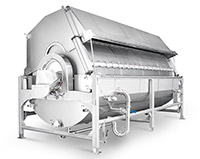
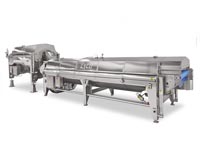
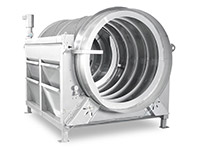
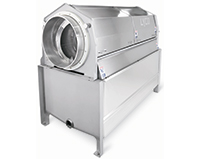
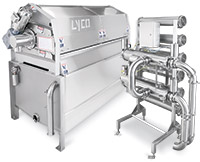
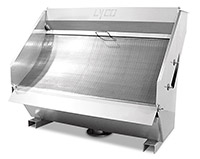
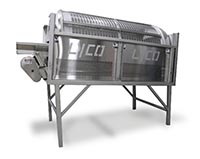
Cooling constraints? Fast, uniform temperature pull-down prevents clumping and hits food safety targets. Lyco’s Easy-Flow® Cooler delivers seconds-level particulate cooling.
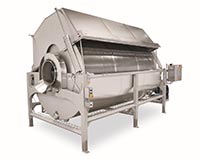
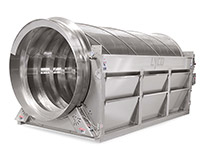
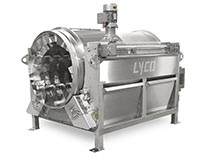
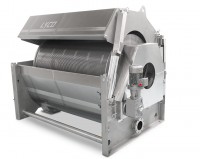
Need cook + cool in one footprint? Combination Cooker-Cooler systems reduce transfers and floor space.
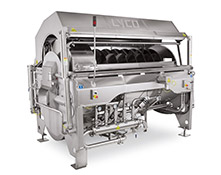
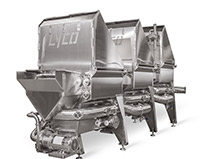
Running multiple particulates? Clean-Flow® continuous blanching/cooking/cooling systems are designed for CIP speed and changeover efficiency.
WHERE TEMPER-FLOW® FITS IN THIS DISCUSSION
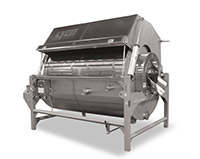
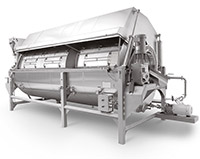
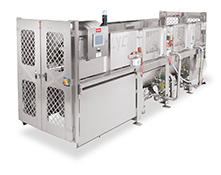
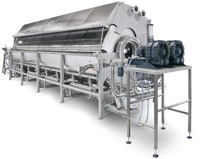
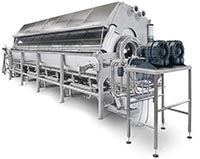
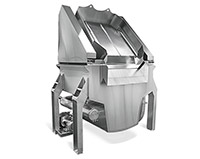
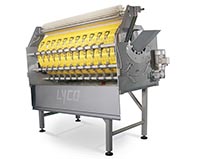
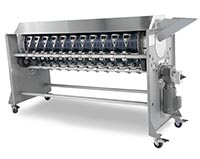
Lyco Manufacturing’s Temper-Flow® system is engineered around the realities above—continuous operation, repeatable control, and the specific needs of industrial fully absorbed rice. The core principle: treat rice like a controlled hydration process, not a “boil and drain” task. Plants that make this shift see improvements in consistency, yield, and downstream handling.