




Rotary Drum vs Belt Cooler for Pouches: What Fits?
ROTARY DRUM VS BELT COOLER FOR POUCHES: WHAT FITS YOUR LINE?
Food safety, shelf-life, pouch integrity, and throughput collide at one place: the cooling step after hot-fill or cook-in-pouch. When processors compare rotary drum vs belt cooler for pouches, they’re solving the same plant-floor problems—core temperature misses, crushed seals, uneven dwell, bottlenecks, and documentation gaps that show up during audits.
The comparison matters more now than five years ago. Higher SKU counts (more pouch sizes, more run changes), tighter FSMA/HACCP verification expectations, rising water/energy scrutiny, and labor shortages that punish equipment requiring constant babysitting—all of it pushes cooling decisions to the front of the line.
Below is a practical framework to help engineering and quality teams evaluate options without over-committing to a specific design too early.
WHAT YOU’RE REALLY CHOOSING: DYNAMICS, NOT JUST HARDWARE
A “rotary drum cooler” and a “belt cooler” represent two different cooling philosophies:
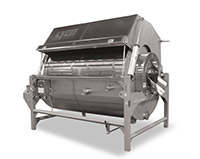
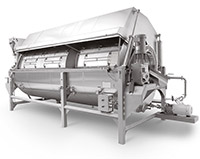
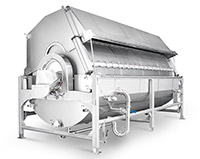
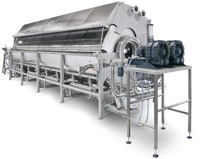
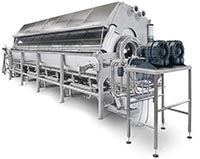
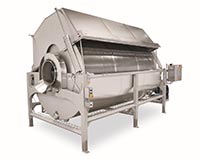
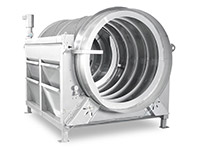
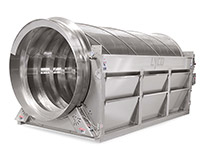
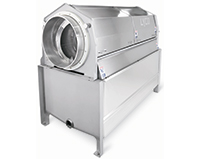
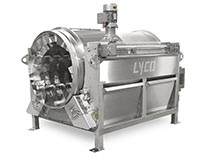
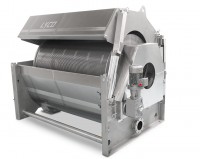
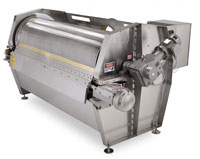
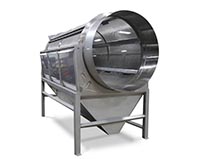
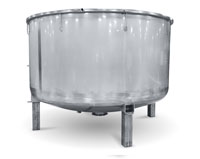
- Rotary drum pouch cooling relies on tumbling/rotation for movement and mixing, with cooling water contacting the pouch exterior
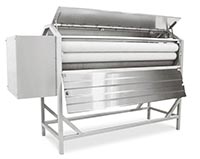
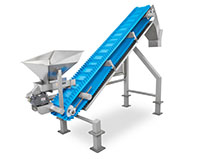
- Belt pouch cooling uses a conveyor with water deluge or immersion sections, moving pouches in a linear path
The decision comes down to whether the system can consistently deliver:
- Repeatable dwell time—even during upstream/downstream disturbances
- Uniform heat transfer—especially with viscous fills (soups, sauces, chowders, pet food loaf)
- Low-damage handling—protecting seals, spouts, and film layers
- Verifiable metrics—for process validation and audit-readiness
BELT COOLERS: WHERE THEY FIT, WHERE THEY STRUGGLE
COMMON STRENGTHS
- Straightforward to understand and service (familiar conveyor architecture)
- Simple integration into existing line layouts
- Works when products are robust and dwell precision is not critical
COMMON PLANT-FLOOR ISSUES
1) Non-uniform cooling across the bed
Belt loading creates “hot spots” when pouches overlap, raft, or ride on top of each other. With multiple pouch sizes, this happens more often than operators expect.
2) Flow is not always true FIFO
If the belt becomes congested or pouches shift, residence time distribution widens—some pouches cool longer, others shorter. That’s a quality and documentation issue, not just an efficiency issue.
3) Pouch handling stress
Deluge + belt transfers introduce scuffing, seal abrasion, or corner damage—especially with high throughput and frequent starts/stops.
4) Validation friction
When auditors ask, “Show me the coldest pouch and prove your dwell time,” belt systems require extensive mapping to characterize worst-case conditions.
PRACTICAL TIP: If a belt cooler is in the running, define maximum allowable overlap, verify belt speed stability under load, and plan for routine belt/nozzle maintenance as a control point—not a “nice-to-have.”
ROTARY DRUM COOLERS: WHERE THEY FIT, WHERE THEY STRUGGLE
COMMON STRENGTHS
- Strong mixing action in the cooling medium can improve external heat transfer
- Potentially compact, depending on configuration and dwell needs
- Effective for consistent pouch geometry and predictable loading
COMMON PLANT-FLOOR ISSUES
1) Product/pouch sensitivity to tumbling
Some pouch formats (spouts, fitments, thin films, sharp corners) don’t tolerate aggressive motion. Damage shows up as micro-leaks, seal stress, or cosmetic issues that become customer complaints.
2) Residence time control varies with loading
If the drum’s internal dynamics change with fill level, dwell distribution widens—raising the “coldest pouch” challenge.
3) Sanitation and inspection access
Rotary designs can be cleanable, but access and verification must be designed-in. If sanitation is a daily constraint, this is a real decision factor.
PRACTICAL TIP: Ask early how the system manages “line upsets”—when upstream surges or downstream pauses happen, what protects dwell time consistency and pouch integrity?
WHAT PROCESSORS ARE PRIORITIZING IN 2026
Across food and pet food, cooling decisions center on:
- Audit-ready process evidence (time/temperature, worst-case pouch, documented control limits)
- Energy and water accountability (utilities cost, internal sustainability metrics, discharge pressure)
- High-mix operations (multiple pouch sizes, multiple viscosities, more changeovers)
- Labor-minimizing reliability (equipment that doesn’t require constant adjustment to stay within spec)
This is why engineering teams are moving from “cooler as a conveyor” thinking to “cooler as a controlled thermal process” thinking.
A THIRD PATH: CONTROLLED SUBMERGED AGITATION
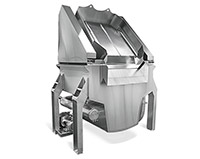
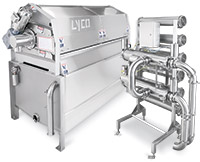
Lyco Manufacturing’s position is direct: the core problem with many traditional designs isn’t speed—it’s repeatable, uniform cooling through the bacterial danger zone, with controlled pouch handling and measurable performance.
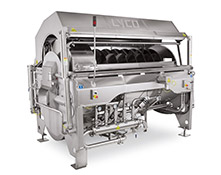
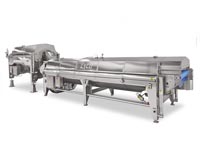
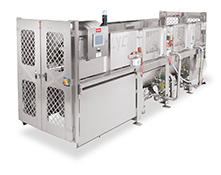
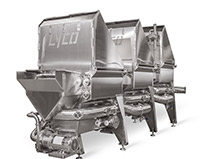
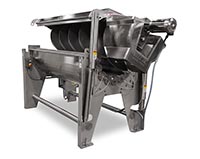
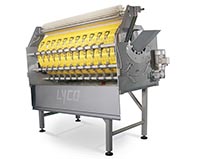
Systems like Chill-Flow™, using patented Hydro-Flow® submerged agitation, are evaluated as an alternative to both deluge belts and drum-style dynamics because they deliver:
- True first-in/first-out flow
- Water-cushioned handling to reduce pouch damage
- Uniform, rapid cooling across pouch sizes
- Smaller footprint relative to long belt runs
We design and manufacture these systems with decades of pouch cooling experience—and we back it with R&D test runs using customer products before a line is committed.
DECISION CHECKLIST: ROTARY DRUM VS BELT COOLER FOR POUCHES
Use this as a scoping tool before you talk equipment specifics:
PROCESS + FOOD SAFETY
- What is the required core temperature at discharge, and how tight is the tolerance?
- What is the maximum allowed time in the danger zone for your product category?
- How will you identify and validate the coldest pouch?
PRODUCT + PACKAGE
- Pouch sizes (minimum/maximum), fill weights, viscosities
- Seal type, spouts/fitments, film robustness, cosmetic requirements
- Damage definition: leak rate target, seal burst targets, scuff tolerance
OPERATIONS
- Throughput (pouches/min), shift pattern, sanitation windows
- Changeover frequency, SKU mix, line upset frequency
- Maintenance realities: nozzles, belts, bearings, access panels
UTILITIES + FOOTPRINT
- Available space and elevation constraints
- Water reuse strategy, filtration needs, discharge limits
- Heat recovery opportunities
PRACTICAL TAKEAWAYS
- If you need simple conveyance cooling and can tolerate wider dwell variation, a belt cooler may fit—provided you tightly control loading and maintenance.
- If you have consistent pouch formats and can validate motion effects on seals and cosmetics, a rotary drum can be effective—provided dwell control under variable load is understood.
- If your drivers are uniformity, FIFO, gentle handling, and validation-ready metrics, benchmark both against controlled submerged agitation designs.