




PREVENTING PASTA CLUMPING IN INDUSTRIAL COOKERS: 10 PLANT-FLOOR FIXES THAT HOLD UP AT SCALE
Pasta clumping isn’t a “pasta problem.” It’s what happens when hydrodynamics, starch release, dwell time control, cooling, and sanitation all drift at once—and throughput demands expose every gap.
We’ve seen it across hundreds of installations. Plants push for longer shelf life, tighter lethality specs, faster chilling, more SKUs, more changeovers. Clumping shows up first. It’s the canary in the cook/chill coal mine.
This is a practical, awareness-level playbook for preventing pasta clumping in industrial cookers—written for operations, engineering, and production leaders who own yield, quality, and compliance.
WHY PASTA CLUMPS IN CONTINUOUS COOKING (THE REAL ROOT CAUSES)
Clumps form when three conditions converge:
- High surface starch (over-agitation in the wrong zone, insufficient rinse/overflow control)
- Product-to-product contact without separation energy (dead zones, low agitation, overloaded bed depth)
- Time/temperature drift (dwell time spread, uneven heating, slow cooling, sticky transfer surfaces)
In multi-product facilities, add a fourth driver: residual starch/fats/oils from prior runs creating instant adhesion on startup.
10 ACTIONABLE WAYS TO REDUCE CLUMPING (WITHOUT GUESSING)
1) CONTROL STARCH—DON’T JUST ADD WATER
“More water” sounds logical. But if it turns your cooker into a starch bath, you’ve made the problem worse.
- Set an objective: target overflow turbidity/solids and hold it stable run-to-run
- Use managed overflow and replenishment so starch doesn’t accumulate and redeposit
- Watch for “cloudy cooker syndrome” late in runs—clumps often spike at end-of-batch
Related search terms: reduce surface starch in pasta cooking, starch management in continuous pasta cookers
2) ELIMINATE DEAD ZONES AND SHORT-CIRCUITING
Clumps form where product slows, piles, or recirculates.
- Map flow behavior: check corners, baffles, level-control swings, inconsistent feed points
- Validate first-in/first-out behavior—mixed residence time creates mixed texture, which sticks
Related search terms: eliminate dead zones in pasta cooker, residence time variation causes pasta sticking
3) MATCH AGITATION STYLE TO THE ZONE
Not all agitation helps. Wrong agitation shears pasta, releases starch, increases tack.
- Early zone: enough separation energy to prevent nesting
- Mid-zone: stable conveyance, minimal product damage
- Discharge: avoid compaction and “matting” before cooling
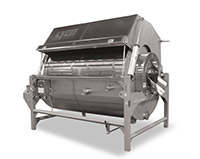
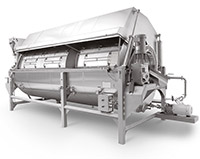
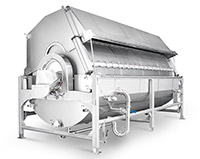
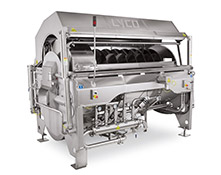
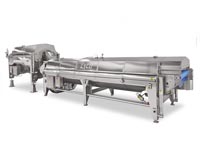
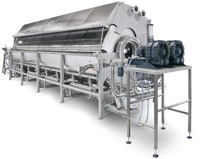
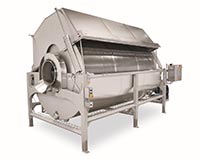
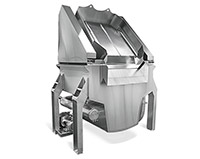
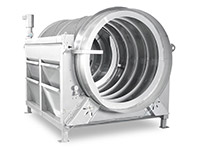
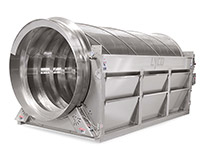
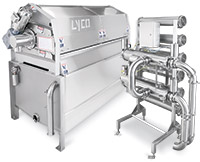
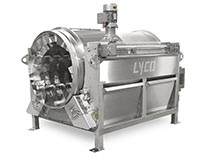
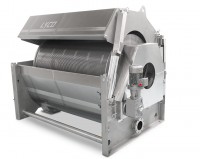
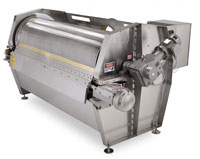
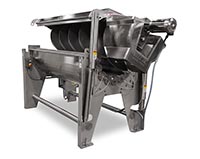
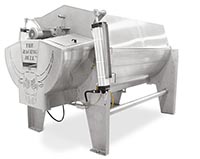
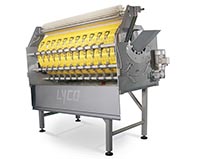
This is where controlled, uniform agitation separates repeatable operation from “operator art.” Lyco’s Hydro-Flow® agitation principles—used across Clean-Flow® and Versa-Flow™ systems—target this exact balance.
Related search terms: agitation design for continuous pasta cookers, uniform agitation prevents pasta sticking
4) STOP OVERLOADING BED DEPTH
Throughput pushes lead to deeper product beds, reduced movement, more contact points, more clumps.
- Simple rule: if bed depth increases, you must increase separation energy or tighten dwell-time distribution
- Trend throughput vs. clump complaints—you’ll find a threshold where quality falls off a cliff
Related search terms: pasta bed depth in continuous cooker, throughput causes pasta clumping
5) STABILIZE FEEDING (SURGE CONTROL)
Clumping correlates with upstream surges from extruders, conveyors, or metering hoppers.
- Add buffering to deliver consistent mass flow
- Avoid slug feeding—slugs create compression zones and localized starch spikes
Related search terms: steady feed prevents pasta clumps, surge feeding in pasta processing
6) RUN DUAL OBJECTIVES: COOK QUALITY + DOWNSTREAM HANDLING
If downstream equipment damages pasta, you’ll misdiagnose the cooker.
- Check discharge elevation drops, tight bends, transfer conveyors
- Clumps can “start” as fragile nests, then become hard masses after compression downstream
Related search terms: pasta clumping after cooking, transfer damage causes pasta sticking
7) COOL FAST ENOUGH TO “SET” THE SURFACE
Slow cooling extends the sticky window.
- Target rapid pull-down to below 40°F where required for safety/shelf-life programs
- Minimize dwell time between cooker discharge and cooling—staging bins are clump generators
Related search terms: rapid cooling prevents pasta sticking, cook-chill pasta clumping
8) FIX SANITATION THAT LEAVES STARCH FILM
A thin starch film on metal is a clump starter, especially on startup after CIP.
- Verify CIP impingement and drain-down—starch likes low-flow areas
- Audit “hidden” surfaces: discharge chutes, screens, covers, transfer points
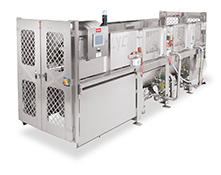
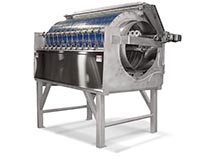
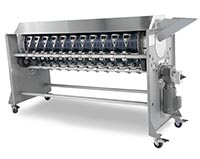
Sanitary, CIP-forward designs like Lyco’s Clean-Flow® are built around faster changeovers and full-coverage cleaning for exactly this reason.
Related search terms: CIP pasta cooker starch film, sanitation reduces pasta clumping
9) CONTROL WATER CHEMISTRY AND TEMPERATURE SWINGS
Hardness, pH, and temperature variability change starch behavior and surface tack.
- Trend incoming water quality and cooker temperature stability
- Seasonal swings in water chemistry = seasonal clumping
Related search terms: water quality affects pasta cooking, temperature stability in industrial cookers
10) INSTRUMENT WHAT OPERATORS CAN’T SEE
If you don’t measure it, you can’t hold it.
- Trend: inlet/outlet temp, overflow rate, turbidity/solids proxy, feed rate, discharge moisture
- Use recipe-driven controls to reduce “tribal knowledge” dependency—especially in labor-short plants
Related search terms: recipe control pasta cooker, monitoring prevents pasta clumping
QUICK DIAGNOSTIC CHECKLIST (USE THIS ON THE NEXT RUN)
| Symptom | Likely Root Cause |
| Clumps increase late-run | Starch accumulation/overflow control issue |
| Clumps increase at higher throughput | Bed depth/agitation mismatch |
| Clumps happen only on certain shapes | Handling + dwell-time distribution |
| Clumps spike after changeover | Residual film/CIP coverage gap |
| Clumps happen before cooling | Cooker hydrodynamics |
| Clumps happen after cooling | Discharge/transfer compression |
CLUMPING IS A SYSTEM KPI
Plants that consistently prevent pasta clumping treat cook/chill as a system: cooking + agitation + liquid-solid separation + cooling + sanitation, controlled by repeatable recipes rather than operator workarounds.
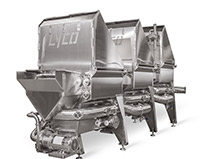
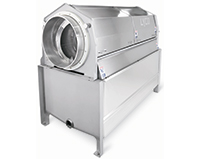
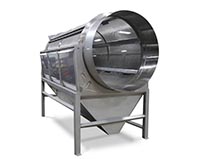
Lyco Manufacturing has built over 850 systems around these principles. For more context on continuous cook/chill and sanitary changeover strategies, explore resources on Clean-Flow®, Versa-Flow™, and Combination Cooker-Cooler systems.